718-257-8584


The Hidden Muscle Behind the Curb
You’ve seen them rumbling down the streets of Brooklyn, gobbling up bags, bins, and busted furniture like a mechanical beast. But have you ever wondered how a garbage truck manages to compress all that waste into what looks like a glorified metal box on wheels?
Turns out, your everyday garbage truck is one of the most powerful vehicles on the street—and not just in terms of size. The compaction system built into commercial rear-loader garbage trucks can exert as much as 2,000 pounds per square inch (psi) of pressure. That’s enough force to crush a couch, a mini fridge, or even a full-size mattress like it’s made of packing foam.
What’s Under the Hood (and the Hopper)
Let’s break down how a typical rear-loader works:
Hydraulic Rams: At the heart of the compactor is a powerful hydraulic ram, usually powered by the truck’s engine or a separate hydraulic system. When activated, the ram pushes the trash against a compaction blade inside the hopper, crushing it into the holding area.
Compaction Ratio: These trucks can reduce waste volume by a factor of 3 to 5. That means what starts as 30 cubic yards of loose trash can be compressed into just 6 to 10 cubic yards of dense material.
Payload: A commercial rear-loader can hold up to 12 tons of compacted trash. That’s equivalent to the weight of about 9 Toyota Camrys or two adult elephants.
Durability: The steel compaction panels are designed to withstand years of daily abuse. We’re talking about half-inch reinforced steel plates crushing objects that would normally destroy your average pickup bed.
Trash vs Titans: A Power Comparison
Let’s compare the crushing power of a garbage truck to some things we often think of as powerful:
|
Machine |
Crushing Power / Force |
Fun Fact |
|
Rear-Loader Garbage Truck |
~2,000 psi |
Can crush multiple refrigerators at once |
|
Industrial Car Crusher |
~2,500 psi |
Compresses entire cars into 2-foot cubes |
|
Crocodile Bite |
3,700 psi |
Stronger than most trucks—but only in one bite |
|
Hydraulic Press (Lab Grade) |
20,000+ psi |
Can pulverize diamonds and titanium |
|
Garbage Disposal (Home) |
~1/50th of a truck |
Struggles with chicken bones 😬 |
So while it might not match the insane pressures of a lab press, your local garbage truck is still a brute in the real world—especially considering it’s mobile, reliable, and designed to handle Brooklyn levels of garbage daily.
Why This Matters for Brooklyn Businesses
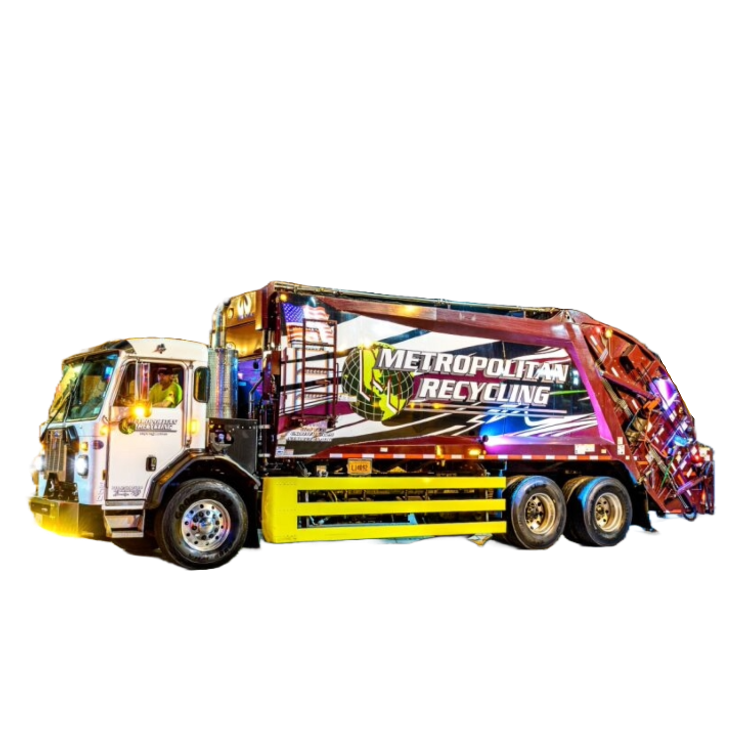
For commercial waste haulers like Metropolitan Recycling, this crushing force is not just for show. It’s about efficiency, volume reduction, and cost savings. In a borough like Brooklyn—where space is tight and schedules are tighter—a compact load means:
- Fewer trips to the transfer station
- Lower fuel use and emissions
- More pickups per route
- Cleaner streets and faster service for clients
Metropolitan’s fleet is equipped to handle all kinds of commercial waste—from grocery stores to office cleanouts—without missing a beat. Their trucks don’t just pick up your garbage. They annihilate it.
Recyclables Get the Same Treatment
While recyclables like paper and cardboard don’t require the same kind of brute force, the same principle applies: compact it down, haul more at once, and reduce handling costs. Many commercial clients in Brooklyn rely on the fast, powerful compaction abilities of their recycling haulers to keep waste bills low and bins from overflowing.
What’s Next: Smart Compaction and Sensors
Modern garbage trucks are getting even smarter. Some new models use load sensors to detect when the truck is full, or AI-powered cameras to detect contamination in recycling streams. Compaction power may stay around 2,000 psi, but intelligence is going up, making future fleets more efficient and environmentally friendly.
The next time you see a Metropolitan Recycling truck roll down the block, just know you’re not looking at just another piece of municipal machinery. You’re looking at a steel-jawed monster that’s strong enough to turn your junk into a neat cube and smart enough to do it better every year.